
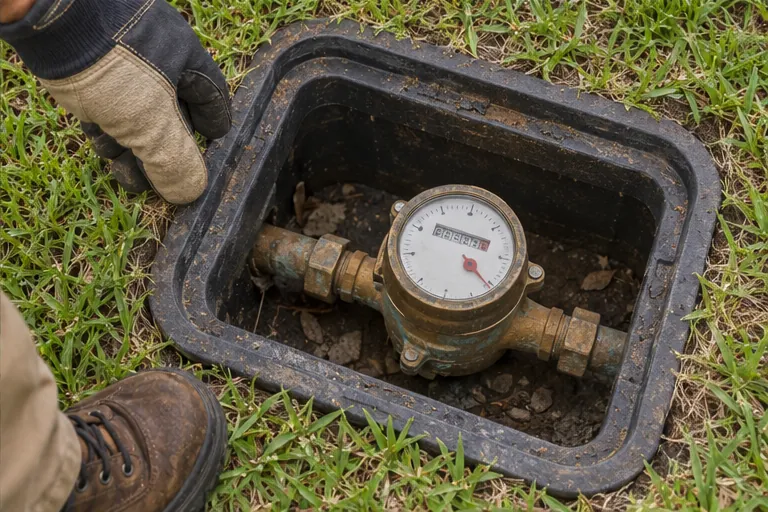
One property, two directions of water
A Palm Bay listing says “well and septic,” and the lender asks for a water test. Before booking a septic flow test, find out which water the lender means. One appointment looks at wastewater leaving the house and what the disposal system does with it. The other collects drinking water for laboratory analysis. A septic evaluator can record where water went without learning anything about the nitrate in a kitchen glass. A laboratory can measure a sample without anyone having located the drainfield.
Establish what serves the kitchen and the bathrooms
Ask the owner two questions separately. Where does indoor drinking water come from? Where does wastewater go when you flush? A house may have city water and a working septic system. A well head in the yard might serve irrigation while indoor plumbing is on the public water supply. Give Palm Bay Utilities the complete street address, including NE, NW, SE or SW, and ask which services are available and which connections they can confirm. Service available at the street is different from service connected at the house. Palm Bay Utilities service availability.
Look for the permit documents alongside the utility response. Brevard says well construction permits from mid-2002 onward are available through its historical records system, and some septic records can be found there too. An owner’s older well may predate that online series. Ask for the completion report, any abandonment record and a sketch showing the location. Compare wells on the drawings with what the owner says is used today. A line labelled “well” on an old plan gives you a lead for verification, not a sampling point. Brevard well records and office contacts.
Order by the decision you need to make
| Question | What to request |
|---|---|
| Is water at the kitchen tap suitable for the closing requirement? | Send the lender’s exact analyte list, collector requirements and deadline to a certified drinking-water laboratory. |
| Does wastewater reach the tank, and what can the evaluator observe in the field? | Arrange a septic evaluation with an agreed written scope. State whether household occupancy, a recent pump-out or drainage trouble affects the visit. |
| Does the private well physically supply enough water under demand? | Ask a qualified well professional about a well yield or performance assessment. A lab sample measures constituents, not the water volume the well delivers. |
| What is reported for my public water supply? | Confirm the utility that supplies the account and get its water quality report. A public-system report describes the utility supply, not a sample from a separate private well. |
For an ordinary private home sale, Florida’s Department of Health says the state does not require well sampling solely because of the transaction. Its purchase guidance recommends coliform bacteria, nitrates and lead and notes that site conditions may call for other tests. A lender or private agreement may set a more specific list. For existing private wells, the state recommends annual coliform and nitrate testing and a lead test every three years for most homeowners. Requirements for newly constructed or repaired wells are a separate question for Brevard. Florida’s private well testing guidance.
Book the sample before buying a kit
Start with a call to the lab. Tell them who will rely on the results, the deadline, whether the home has treatment equipment and which tap supplies drinking water. Ask which containers they provide, how soon each sample must arrive and who is permitted to collect it. A sample taken correctly for a homeowner’s information can still be unacceptable for a transaction if the recipient requires an independent collector or a documented chain of custody.
Brevard’s well office specifically says it can accept coliform bacteria samples only. That is a useful distinction if your lender requests bacteria, nitrate and lead on the same written report. Ask a certified lab whether it handles all the requested analyses, whether it arranges collection and exactly which result will be delivered when. The Department of Health posts its laboratory certification program, and Brevard publishes collection instructions and an explanation of sample results. Brevard drinking-water guidance. Florida laboratory certification.
Do not improvise the collection from a spare kitchen bottle or from a convenient outdoor tap. Different analyses can require different containers, preparation and sampling conditions. Ask the lab to identify the correct collection point relative to filters, softeners or other treatment equipment. A sample before treatment can answer a different question from the glass of water the family actually drinks. Record the fixture and any treatment in the lab paperwork. Confirm the return window before scheduling a late-Friday visit.
Read results as evidence for the right system
If the laboratory reports a bacterial indicator, ask which organism or indicator was detected, the collection point and the lab’s interpretation. Contact Brevard Environmental Health about precautions and follow-up. A positive result alone cannot pinpoint a septic system as the source. Similarly, a satisfactory lab result for the substances tested does not clear the tank or field. Label each report with the address, date and purpose so a future buyer can see precisely which question it answered.
If recent floodwater reached the well, tell the health department and laboratory before collecting. Florida’s flooded-well guidance identifies an alternative safe supply, including bottled water, for drinking and food preparation during uncertainty. Follow the county’s instructions for return to use and testing. A septic flow appointment addresses a separate problem and cannot clear a flooded well for drinking. Florida Department of Health flood guidance.
Give the closing file a simple index
Save the utility’s service confirmation, the well permit or completion report, the laboratory result, the septic site plan and the signed evaluation as separate documents. Add the signer and date to each filename. If a condition is outstanding, record who requested it and the exact wording. A lender following up about the bacteria result then gets the lab document immediately. The contractor asking about the field gets the site plan and evaluation. Nobody has to guess which “water test” the email refers to.
Questions about well water testing
Can Brevard Environmental Health run the full set of well tests for a closing?
Brevard’s well construction office says it can accept coliform bacteria samples only. Get the lender’s requested list, then arrange the remaining analyses through a state-certified drinking-water laboratory with the appropriate capabilities.
The yard has an irrigation well. Does that mean the kitchen water comes from it?
No. Check the active potable water service with the utility and ask the seller or a qualified professional to identify the household supply. A separate well can serve irrigation while city water serves the indoor fixtures.
Does a coliform finding prove the drainfield is leaking?
A bacterial indicator in a water sample calls for follow-up with the laboratory and health department. It does not identify a specific source. Preserve the sampling location, conditions and results, then discuss the well and septic evidence separately.
Which private-well tests does Florida recommend for ongoing household use?
The Florida Department of Health recommends annual coliform bacteria and nitrate tests and, for most households, a lead test every three years. Your well’s condition or activity near the property may warrant further testing.
When ordering well water testing, confirm the laboratory and sample requirements separately from the wastewater evaluator’s scope.