
Start with the land, then search the septic archive
Find the parcel on the Brevard County Property Appraiser’s map. Copy the physical street address, parcel ID and the legal description, including the subdivision, unit, block and lot where listed. Then open the historical records link on Brevard Environmental Health’s construction permits page. The first website tells you which piece of land you are researching. The second may hold the septic application, drawing or inspection for that land.
Keep the street suffix and compass direction in your notes. “SE” or “NW” on a Palm Bay address is easy to lose when someone forwards a listing, scans an invoice or types a house number into a search box. Also check whether the address you were given is the owner's mailing address. The address at which a tax bill arrives can be miles from the drainfield.
Try the county’s house-number shortcut
The historical records are scanned documents indexed in Laserfiche. Open the public viewer from Environmental Health. The agency provides its public sign-in information there. Choose the template search and select Brevard Cty Environment Health for septic records. A separate template holds well records, which matters on a parcel with both a well and a tank.
Brevard’s illustrated instructions recommend an exact-match search with the street number followed by an asterisk. For a house numbered 418, try 418*. This retrieves records indexed with that beginning. Expect unrelated streets and longer numbers starting with those digits. Compare subdivision and block before opening a promising result. If the address still produces nothing, try the block or subdivision field. If an old report mentions an onsite sewage permit number, use the permit-number field directly.
Match the document to your lot
A familiar street name is a starting point. Read the legal description on the scan and compare it with the parcel record. Check the unit number as well as the block and lot. A development can have a similarly numbered block in a different unit. If a lot was combined or subdivided, the current parcel outline may include land described differently in an older document. Save the scan and ask Environmental Health to reconcile the identifiers before relying on it.
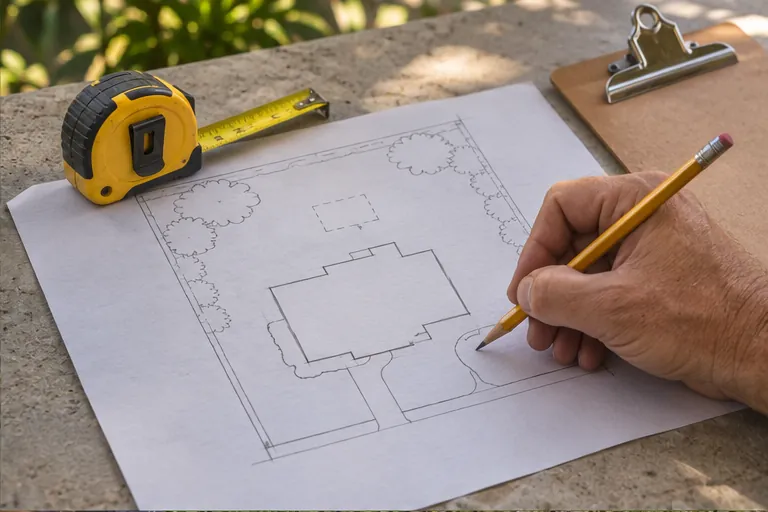
Look at the footprint next. Does the drawn house face the right street? Is the garage on the expected side? Do the road frontage and any labeled easements fit? Those are useful cross-checks when scans are faint. A matching roofline alone cannot establish the legal parcel or the exact location of a buried component. A renovated house can look different from its original drawing.
Ask one question of each document
| Document | What to look for | What you still need |
|---|---|---|
| Initial application or construction permit | Which system and building were submitted or approved? | A final or installation record for what followed. |
| Final record or as-built drawing | What layout and components were documented at completion? | Later repair or abandonment records and present condition. |
| Repair or modification file | Which part changed, and when? | The scope and any final record for that particular job. |
| Abandonment file | Which tank or system was taken out of use? | Confirmation of what currently serves the building. |
Keep the permit number, date and document type in the file name. Preserve all pages. A screenshot of a tank sketch can lose a final approval stamp, scale or note explaining that a second drawing superseded it. Laserfiche’s PDF export is built into the viewer. If words on a scan are illegible at full size, describe which field you cannot read when asking the office for help.
Check the legacy search by date
Brevard County’s Legacy Permit Search also covers septic permits. The county describes its coverage as building permits from 1990 through 2002 and other permits from 1990 through 2007. Use it as another place to find a reference number for a job from that era. An empty result for a 2014 project tells you little. That date is outside the stated window.
Suppose the seller bought a house built in 1998 and remembers a drainfield repair around 2015. Search for the initial file and the repair separately. Ask for both dates. A contractor’s receipt for work in 2015 could lead you to the newer permit even when the original installation appears first. Keep both in date order so the inspector can see why a sketch of the original field may point to the wrong side of the house.
When the search still comes up empty
Give Brevard Environmental Health the property address, parcel ID, full legal description, approximate construction and repair years, plus any permit numbers you found. Ask specifically for the original installation, final or as-built records, repairs, modifications and abandonment, as relevant. Their construction permits page lists Environmental Health at 321-633-2100. State whether you need help locating a document or want to apply for a new permit. Those requests take different paths.
If you are working to a closing deadline, make a short record of the date you searched, the databases you tried and what remains outstanding. Ask the seller for pumping receipts, maintenance agreements, prior evaluations and utility connection paperwork. A person who lived there may remember access difficulties or where a repair truck parked. Pass that information along as a lead for the evaluator, with its source identified.
What to hand the person visiting the property
Send a tidy packet with the parcel record, original drawing, later repair documents and a short list of conflicts. One useful instruction is, “The 1998 drawing shows the original field. There is a 2015 repair invoice but we do not yet have a revised layout. Please state which area you could identify.” That gives the evaluator a real question to answer and explains the uncertainty to anyone reading the report later.
Leave buried-component location and access to the professional. A permit search can help plan a visit and a missing permit can be documented. Neither a scan nor an empty archive describes how the system is performing this afternoon.
Questions about Brevard septic permit
Which Laserfiche template contains the Brevard septic files?
Choose Brevard Cty Environment Health in the template search. The similarly named well template holds a different set of permits. Brevard’s construction permits page links to the current viewer.
Why search a Palm Bay house number with an asterisk?
The county demonstrates it as a prefix search. It can find entries when the street spelling is inconsistent. Match the subdivision, block, lot and unit before treating a result as yours.
I found a permit and a newer repair receipt. Which should I send?
Send both with their dates. Ask for the repair permit and its final drawing, if available. The receipt may identify an area or contractor that does not appear on the original plan.
Can I tell a buyer the home is on sewer because no septic file turned up?
Confirm connection with the serving utility and request available abandonment records for the address. A blank search records what you found in that archive, not how wastewater currently leaves the house.
Save the parcel identifier with each Brevard septic permit you find, including amendments, final records and abandonment paperwork.